
How Semantic SEO Keeps You Ranking on Google in 2026
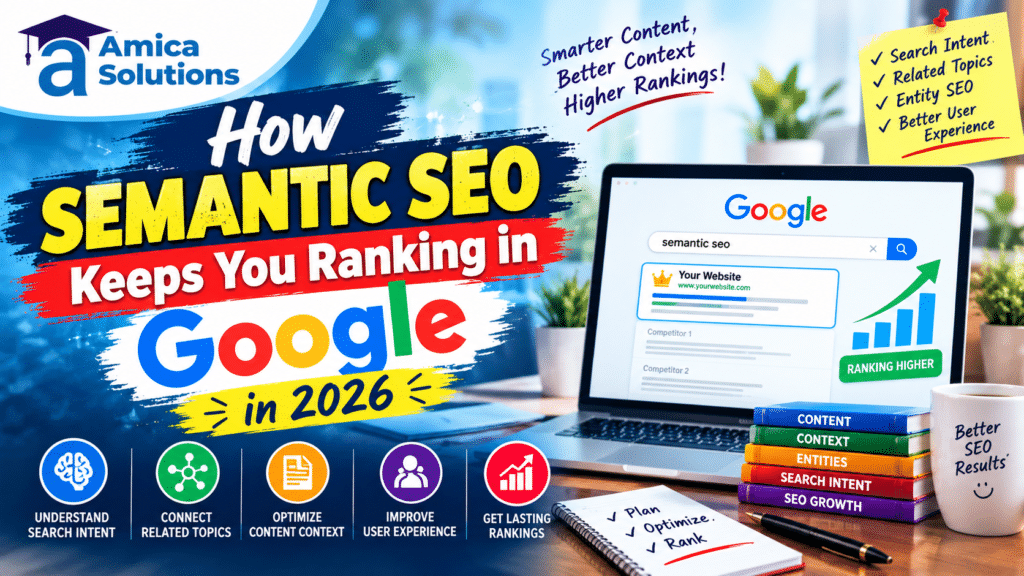
In the rapidly evolving landscape of search engine optimization, semantic SEO has emerged as the cornerstone of sustained ranking success. Unlike the keyword-stuffing tactics of the past, modern semantic SEO focuses on understanding user intent, context, and the relationships between concepts. This comprehensive guide explores How Semantic SEO Keeps You Ranking on Google in 2026 and why digital marketing agencies like Amica Solution are prioritizing these strategies for their clients.
What Is Semantic SEO in 2026?
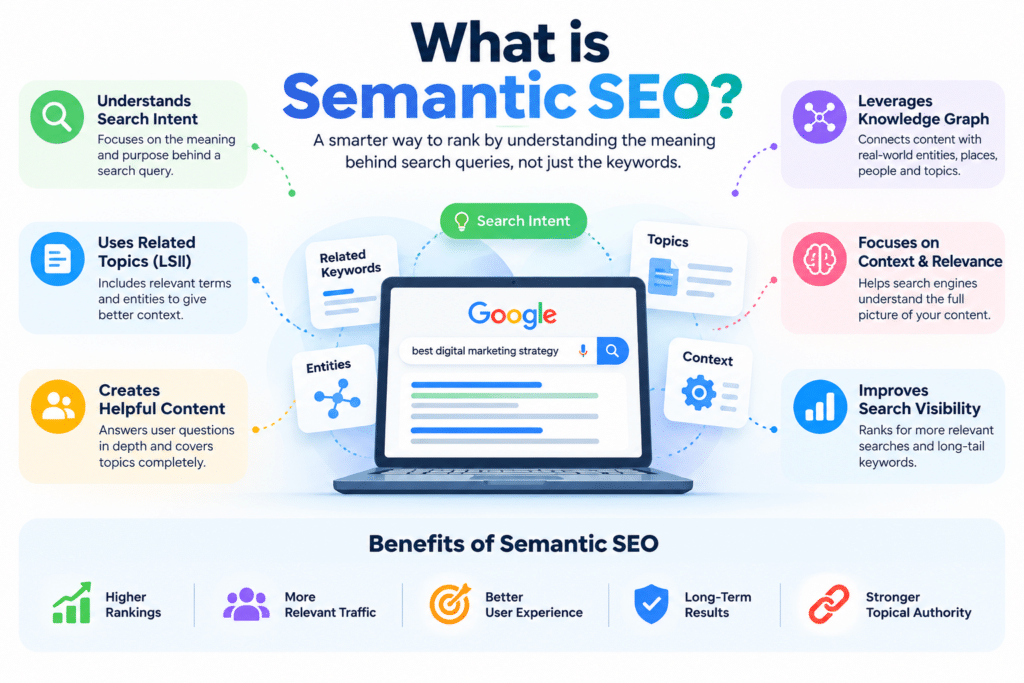
Semantic SEO represents a fundamental shift in how search engines and content creators approach optimization. Rather than targeting isolated keywords, semantic SEO emphasizes meaning, context, and the connections between related concepts.
In 2026, semantic SEO encompasses:
- Understanding search intent beyond surface-level keyword analysis
- Entity recognition and relationship mapping between topics
- Natural language processing integration with Google’s AI capabilities
- Topical authority development through comprehensive content
- User experience signals that demonstrate content value
Google’s evolution toward semantic understanding means that websites rank not just because they mention keywords, but because they provide comprehensive, interconnected information that satisfies user needs at multiple levels. Digital marketing agencies in Dehradun, such as Amica Solution, have adapted their SEO strategies to incorporate these semantic principles, helping businesses establish long-term ranking stability.
How Google Understands Search Intent
Search intent—what a user actually wants to accomplish—has become Google’s primary ranking factor. The search engine uses semantic analysis to determine whether content matches the searcher’s underlying goals, not just their keywords.
Google recognizes four primary intent categories:
- Informational Intent – Users seeking knowledge or answers
- Navigational Intent – Users looking for specific websites
- Commercial Intent – Users evaluating products or services
- Transactional Intent – Users ready to complete purchases
Semantic SEO requires analyzing the intent behind your target keywords and creating content that aligns precisely with what users seek. For instance, if someone searches “best digital marketing strategies for small businesses,” they have commercial-informational intent—they want guidance while considering solutions. Content addressing this requires both educational depth and subtle service positioning, similar to how Amica Solution approaches their content marketing strategy.
Semantic SEO vs Traditional Keyword SEO
The distinction between semantic SEO and traditional keyword-focused approaches clarifies why modern strategies outperform legacy methods.
| Aspect | Traditional Keyword SEO | Semantic SEO |
|---|---|---|
| Focus | Exact keyword matching | Meaning and context |
| Content | Keyword-dense pages | Natural, comprehensive coverage |
| Rankings | Volatile, keyword-dependent | Stable, intent-based |
| User Experience | Often poor (keyword stuffing) | Excellent, user-centric |
| Longevity | Short-term gains | Long-term sustainability |
| AI Compatibility | Low readiness | High AI-optimization |
| Update Resilience | Vulnerable to algorithm changes | Resistant to updates |
Traditional SEO focused on keyword density and exact-match optimization, often resulting in awkwardly written content that satisfied algorithms but frustrated users. Semantic SEO prioritizes genuine helpfulness, allowing keywords to appear naturally while maintaining readability and engagement. Professional SEO services, including those offered by digital marketing companies specializing in search engine optimization, have completely transitioned to semantic approaches.
Why Search Intent Matters More Than Exact Keywords
Here’s the critical truth: the exact keyword phrase users type matters far less than understanding why they typed it. Google’s semantic algorithms can recognize that “How to improve Google ranking” and “techniques to rank higher in search results” address the same intent, even though the keywords differ completely.
This shift impacts content strategy profoundly:
- Users don’t think in keywords; they think in problems and solutions
- Google rewards content addressing the complete context of a search
- Long-tail keywords naturally emerge when serving intent comprehensively
- Featured snippets and AI Overviews favor semantically rich content
- Rankings stabilize because content remains relevant across keyword variations
When Amica Solution develops content marketing strategies for clients, their team recognizes that addressing search intent comprehensively creates content assets that rank for hundreds of related variations—without artificial optimization.
Building Topic Clusters for Better Rankings
Topic clusters—also called pillar-cluster models—organize content to demonstrate topical authority and semantic relationships. A central “pillar” page covers broad topics, with “cluster” pages exploring specific subtopics, all internally linked to show thematic connections.
Topic Cluster Structure:
Pillar Page: "Complete Guide to Digital Marketing"
  ├─ Cluster: "SEO Fundamentals"
  ├─ Cluster: "Content Marketing Strategies"
  ├─ Cluster: "Social Media for Business Growth"
  ├─ Cluster: "Email Marketing Best Practices"
  └─ Cluster: "Google My Business Optimization"
This structure demonstrates topical authority to Google’s semantic algorithms. When Google encounters your pillar page and associated clusters, it recognizes you as a comprehensive resource for that entire topic. For businesses seeking SEO services, agencies like Amica Solution implement topic clustering to position clients as authorities within their niches, especially effective for Google My Business ranking—one of Amica Solution’s specialized services.
How Entities and Relationships Strengthen Content
In semantic SEO, “entities” are distinct, recognizable things: people, places, organizations, concepts. Google maintains a massive knowledge graph connecting these entities and their relationships. Content featuring clearly defined entities and their relationships ranks better than content with ambiguous subjects.
For example, instead of writing vaguely about “digital solutions,” specify:
- Which company (named entity)
- Serving which industry (related entity)
- In which location (geographic entity)
- Solving which specific problem (conceptual entity)
This approach is particularly valuable for local SEO. When Amica Solution helps businesses optimize Google My Business listings—a core service with demonstrated results of top-5 ranking within 2 months—they emphasize location entities, business category entities, and service-related entities. This semantic clarity directly improves local ranking visibility.
Using Related Keywords and Concepts Naturally
Semantic SEO doesn’t eliminate keywords; it transforms how they’re used. Instead of repeatedly using a single phrase, incorporate related keywords and conceptual variations naturally throughout content.
For “semantic SEO keeps you ranking in Google in 2026,” naturally incorporate:
- Semantic search optimization
- AI-ready content
- Topical authority development
- Search intent alignment
- Entity relationship mapping
- User experience signals
- Featured snippet optimization
These variations appear naturally when you’re truly addressing the topic comprehensively. They shouldn’t feel forced or included merely for algorithmic purposes. Modern content marketing, as practiced by digital marketing agencies emphasizing quality over manipulation, uses this semantic expansion to create rich, authoritative content.
Semantic SEO and Google's AI Search Features
Google’s integration of AI into search—including AI Overviews (previously called SGE) and conversational search—fundamentally validates semantic SEO approaches. AI systems excel at semantic understanding and struggle with traditional keyword targeting.
AI search features reward content that:
- Explicitly explains concepts and relationships
- Provides comprehensive, nuanced information
- Demonstrates expertise and authority
- Cites sources and acknowledges complexity
- Uses clear, natural language
- Answers follow-up questions proactively
When optimizing for AI-driven search, think about how an AI assistant would summarize your content to answer a user’s complete question. AI Ready content—created specifically for algorithmic comprehension—often performs better in both traditional rankings and AI Overviews. This represents a significant advantage for businesses partnering with forward-thinking digital marketing agencies that understand AI’s trajectory.
How E-E-A-T Supports Semantic Relevance
Google’s E-E-A-T framework (Experience, Expertise, Authoritativeness, Trustworthiness) has become inseparable from semantic SEO success. The framework ensures that semantic analysis favors genuinely credible, valuable content.
E-E-A-T elements strengthen semantic signals:
- Experience: Demonstrate real-world knowledge of your topic
- Expertise: Show deep understanding of subject matter
- Authoritativeness: Cite credentials, awards, recognition
- Trustworthiness: Provide transparent information, cite sources, acknowledge limitations
For content about digital marketing services or SEO strategies, E-E-A-T requires demonstrating actual experience delivering results. Amica Solution’s content marketing approach includes case studies, client testimonials, and documented results (such as their Google My Business service achieving top-5 rankings within 2 months), which strengthen E-E-A-T signals semantically.
Optimizing Content for AI Overviews and Featured Results
Featured snippets and AI Overviews increasingly dominate top positions, meaning semantic optimization must account for AI extraction and presentation.
Optimization tactics include:
- Definitions: Begin sections with clear definitions of key concepts
- Lists: Organize information in numbered or bulleted formats
- Tables: Comparison tables for semantic relationships
- Examples: Concrete examples showing concept application
- Questions and Answers: Direct Q&A addressing specific searches
- Structured Data: Schema markup clarifying entity relationships
When content includes these elements, Google’s AI systems can more easily extract relevant information for featured results. For businesses in competitive markets like digital marketing services, appearing in featured results significantly increases visibility and click-through rates.
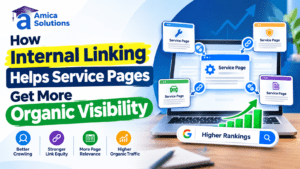
Internal Linking for Topical Authority
Strategic internal linking is the connective tissue binding topic clusters and demonstrating topical authority to Google’s semantic algorithms. Each link should use anchor text reflecting the relationship between pages.
Internal linking best practices for semantic SEO:
- Link contextually within content (never in footers or sidebars for semantic value)
- Use descriptive anchor text revealing content relationships
- Create bidirectional links showing topical interdependence
- Link from high-authority pages to developing topics
- Ensure linking structure reflects logical semantic relationships
For instance, an article on “Google My Business optimization” might link to internal pages about “local SEO strategies,” “review management,” and “service area targeting”—semantic relationships supporting both user navigation and algorithmic understanding. This internal linking approach is fundamental to how professional SEO services structure content strategies.
How to Create Comprehensive, Helpful Content
Comprehensiveness—addressing topics thoroughly rather than superficially—is the foundation of semantic SEO success. Comprehensive content signals topical mastery to both users and algorithms.
Creating comprehensive content requires:
- Research: Understand what competitors cover and identify gaps
- Depth: Explore subtopics thoroughly with supporting evidence
- Breadth: Address multiple angles and perspectives
- Integration: Show how concepts relate and build on each other
- Examples: Use concrete examples making concepts tangible
- Updates: Regularly refresh to maintain currency
When developing content marketing strategies, agencies evaluate competitor content to ensure their content provides superior depth and breadth. This competitive research often reveals opportunities where comprehensive treatment of topics creates ranking advantages.
Common Semantic SEO Mistakes to Avoid
ven with semantic SEO’s advantages, several implementation mistakes undermine its effectiveness:
- Keyword Stuffing 2.0: Forcing semantic variations unnaturally
- Ignoring User Experience: Optimizing only for algorithms, not humans
- Shallow Content: Covering topics without adequate depth
- Inconsistent Entities: Referring to concepts by different names (confuses AI)
- Broken Topic Clusters: Internal linking structures that don’t reflect relationships
- Ignoring Search Intent: Ranking for keywords users never search
- Poor E-E-A-T Signals: Lacking credibility markers and expertise demonstration
- Static Content: Never updating or refreshing aging content
These mistakes often result from treating semantic SEO as a technical exercise rather than a philosophy centered on genuine user value. Modern content marketing emphasizes avoiding these pitfalls through user-centric approaches.
How to Measure Semantic SEO Performance
Measuring semantic SEO success requires different metrics than traditional keyword ranking tracking. While rankings matter, semantic SEO’s complete impact requires broader analysis:
Key Performance Indicators:
| Metric | Significance |
|---|---|
| Organic Traffic | Overall search visibility and user interest |
| Featured Snippet Captures | Semantic comprehensiveness recognition |
| AI Overview Inclusion | Content quality and relevance signals |
| Topic Cluster Performance | Topical authority development |
| Long-tail Keyword Rankings | Semantic variation understanding |
| Click-Through Rate | Content relevance to search intent |
| Dwell Time | Content value and engagement |
| Conversion Rate | User satisfaction and intent matching |
Advanced analytics reveal whether semantic SEO investments are building sustainable, compounding ranking advantages. Agencies tracking these metrics can demonstrate semantic SEO’s long-term value compared to short-term keyword ranking tactics.
Conclusion
Semantic SEO keeps you ranking in Google in 2026 because it aligns with Google’s fundamental mission: connecting users with genuinely valuable information. While algorithms evolve and new ranking factors emerge, the core principle remains unchanged—create content that truly serves users’ intent and demonstrates expertise.
For organizations seeking professional guidance on semantic SEO implementation, Amica Solution offers comprehensive digital marketing services including advanced SEO strategies, content marketing, and Google My Business optimization with documented results. Their Dehradun-based team combines strategic expertise with practical implementation, helping businesses establish topical authority and semantic relevance.
Call us at +91 9411339575
or visit amicasolution.com to book a free consultation.
Visit us at – Amica Solutions Pvt. Ltd
Frequently Asked Questions About Semantic SEO
Q: Does semantic SEO mean I should ignore keywords entirely?
A: No. Keywords remain important for understanding search intent, but they’re one component of semantic SEO rather than the primary focus.
Q: How long before semantic SEO produces ranking improvements?
A: Comprehensive semantic optimization typically shows measurable improvements within 2-3 months, with compounding benefits extending 6+ months.
Q: Is semantic SEO necessary for small businesses?
A: Absolutely. In fact, small businesses often gain proportionally greater advantages from semantic SEO because it compensates for limited domain authority through superior content quality and relevance.
Q: How does semantic SEO interact with local SEO?
A: Geographic entities are crucial to semantic understanding. Properly structured local content—optimized by services like Google My Business ranking—leverages semantic signals for enhanced local visibility.
Q: What's the relationship between semantic SEO and content marketing?
A: Modern content marketing is essentially semantic-first marketing. Quality content marketing naturally incorporates semantic principles.
Contact Us
Recent Posts




Written and reviewed by
Amica Solutions Team
Amica Solutions is a digital marketing company in Dehradun working on SEO, Google Business Profile management, Google Ads, social media marketing, content marketing, website development, and lead generation for local businesses.
- Office: Laxmi Tower, Near Sahastradhara Road, B Block, Aman Vihar, Dehradun, Uttarakhand 248001
- Phone: +91 9411339575
- Email: contact@amicasolution.com