Google's November 2026 Core Update: What Local Businesses Should Check (and What to Leave Alone)
By the Amica Solutions Team · Published 14 November 2026 · Facts checked 14 November 2026. The update is still rolling out, so we will update this page when Google marks it complete.
Google started its November 2026 core update on 10 November 2026, and Google says it may take up to two weeks to finish. If your calls or rankings are moving this week, do not rush to rewrite your website. Wait until Google marks the rollout complete, then compare a full week after it with a normal week before it in Search Console.
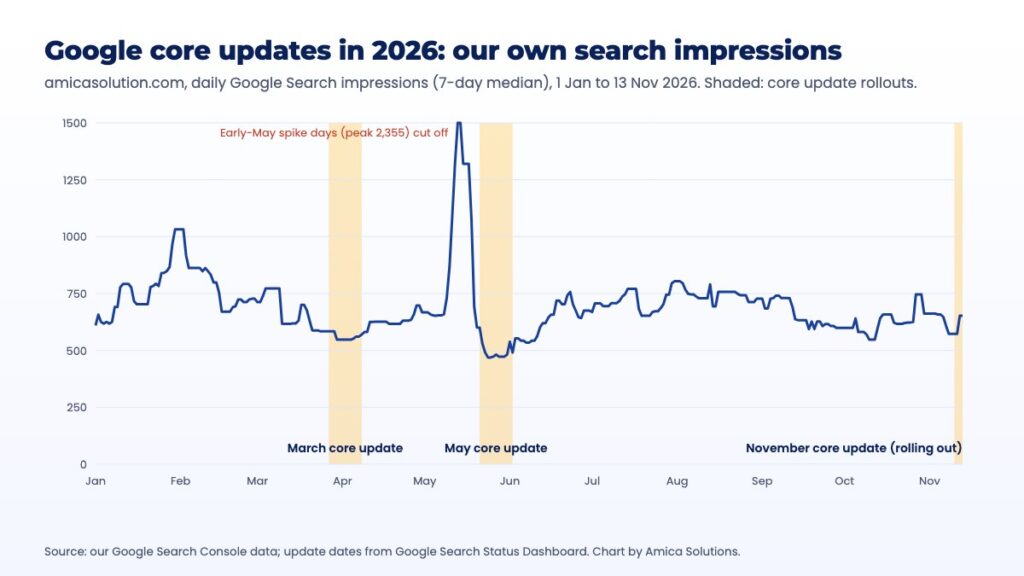
Our own Google Search impressions in 2026, with each core update rollout shaded. Source: our Google Search Console data.
If you run a shop, a clinic or a coaching centre, a Google update can feel personal. The phone is quieter on Tuesday, a competitor suddenly shows above you, and you start wondering what you did wrong. Most of the time the honest answer is: nothing yet. Rankings move around while an update rolls out, and decisions made in that week are often the ones people regret.
We watched our own website, amicasolution.com, through the two earlier core updates of 2026. The chart above is our real Search Console data, not an illustration. In this guide we explain what this update is, what Google itself advises, and how to read your own numbers without fooling yourself, which, as you will see, we nearly did.
Key takeaways
- The November 2026 core update started on 10 November 2026 at 10:06 a.m. Pacific time (11:36 p.m. in India). It is Google’s third core update of 2026, after March and May.
- Google says it may take up to two weeks. The March and May 2026 updates each took about 12 days.
- A core update is not a penalty. Google advises against “quick fix” changes and says small ranking moves need no drastic action.
- Judge it with a full week after the rollout ends, compared with a normal week before. Watch out for festival weeks and one-off spike days.
- Google Maps and the local pack rank on relevance, distance and prominence. Google says nobody can pay for a better local ranking.
What is the Google November 2026 core update?
A core update is a broad change to the systems Google uses to rank web pages. It is not aimed at one website or one industry. Google describes core updates as changes made several times a year to improve search results overall, and it announces them on the Google Search Status Dashboard. A spam update is different: it targets pages that break Google’s spam policies.
Google listed the November 2026 core update on the dashboard on 10 November 2026. According to Search Engine Journal’s report the same day, Google’s entry says it “applies globally and to all languages”, so Indian businesses and Hindi pages are included. Google also posted about it on the Search Central LinkedIn account; there was no Search Central blog post.
Here is every core and spam update Google has listed on its dashboard in 2026 so far:
| Update | Started | Rollout time (Google’s dashboard) |
|---|---|---|
| March 2026 spam update | 24 March 2026 | 19 hours, 30 minutes |
| March 2026 core update | 27 March 2026 | 12 days, 4 hours |
| May 2026 core update | 21 May 2026 | 11 days, 21 hours |
| June 2026 spam update | 24 June 2026 | 2 days, 1 hour |
| August 2026 spam update | 18 August 2026 | 2 days, 16 hours |
| September 2026 spam update | 24 September 2026 | 13 days, 16 hours |
| November 2026 core update | 10 November 2026 | Still rolling out on 14 November (Google: up to 2 weeks) |
How long will the rollout take, and should I change my website now?
Expect movement until about 24 November 2026, and change as little as you can until then. Google says this update may take up to two weeks. Both earlier core updates this year finished in about 12 days, but that is a pattern, not a promise, so check the dashboard rather than the calendar.
Google’s guidance on core updates is clear on two points. Small drops, such as moving from position 2 to 4, generally need no drastic action. And sites should avoid “quick fix” changes; Google prefers lasting improvements that help people. It also says deleting content should be a last resort.
We know waiting is hard when a slow week means real money. But if you rewrite three service pages on Wednesday and your rankings change on Friday, you will never know whether the update or your edit caused it. There is one exception: real technical faults, such as a site that is down, a page wrongly set to “noindex”, or a broken enquiry form. Those are not about the update, and you should fix them straight away.
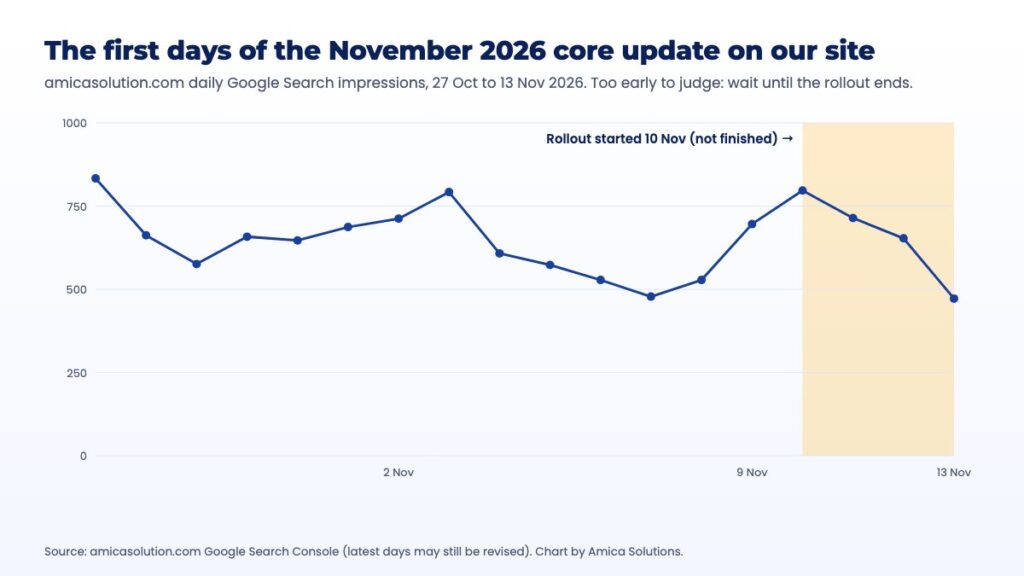
The first days of the November 2026 rollout on our site: normal ups and downs so far. Source: our Google Search Console data.
On our own site the first four days look like ordinary ups and downs, well inside the range of the weeks before. The last day in the chart is still being filled in by Google, so it may rise. That is exactly why the first days of a rollout tell you very little.
How do I check if the update affected my business?
Compare a full week after the rollout ends with a normal week before it, in Search Console, and look at queries and pages rather than one total. This is the method Google describes in its core update and traffic drop guides, adapted for a small business:
- Check that the rollout has finished on the Search Status Dashboard.
- Wait at least one more week, so you have a full, clean week of data after the update.
- Open Performance in Search Console, use the Compare option, and put that week next to a normal week from before 10 November.
- Break it down. Look at the Queries and Pages tabs and sort by the difference in clicks. A drop on one page is a very different problem from a drop everywhere.
- Check the search type. Web, Image and Video results are counted separately, and a change in one can hide inside the total.
- Rule out the season. Google suggests checking Google Trends for your main searches, because people simply search less at some times of year.
That last step matters a lot this month. Diwali fell on Sunday, 8 November 2026, inside the obvious “week before” (3 to 9 November). For sweet shops, gift stores, salons and many service businesses, that was not a normal week. Pick an ordinary week in late October as your baseline instead.
Here is the mistake we almost made ourselves. When we first compared the week before the May 2026 core update with a week after it ended, our average daily impressions seemed to fall by a third. It looked like the update had hurt us.
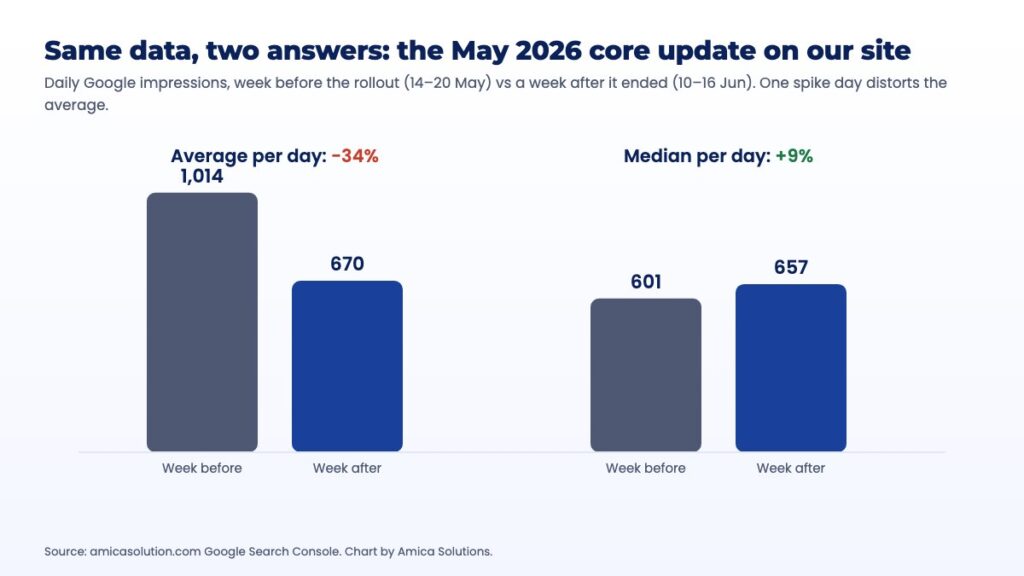
Average vs median: one spike day made the May update look like a 34% drop. Source: our Google Search Console data.
It had not. The “week before” contained a one-day spike: on 12 May our home page alone recorded 15,486 impressions, against a normal 15 to 250 a day. That one day pulled the average up. The median, which ignores single extreme days, tells the real story: a small rise. Here are our own numbers for both 2026 core updates:
| amicasolution.com (Google Search) | Median impressions per day | Average impressions per day | Clicks in the week | Average position |
|---|---|---|---|---|
| Week before March update (20–26 Mar) | 584 | 582 | 40 | 16.9 |
| Week after it ended (16–22 Apr) | 617 | 603 | 36 | 15.8 |
| Week before May update (14–20 May) | 601 | 1,014 | 49 | 11.1 |
| Week after it ended (10–16 Jun) | 657 | 670 | 30 | 10.2 |
Two honest notes. Our clicks fell a little after both updates, but with 30 to 50 clicks a week, a handful of clicks either way is normal noise. And we were also publishing and rebuilding pages during those months, so we do not claim the update “helped” us. The lesson is about method: use the median, look at single days, and never decide from one total.
If you also use Google Analytics, Google published a new page on 12 November 2026 on identifying visits from Google Search. It explains that Google sends only its domain, such as https://www.google.com/, as the referrer, so analytics will never match Search Console click for click. Our beginner’s guide to Google Analytics shows where to find that traffic.
Does a core update change my Google Maps and local pack rankings?
Google has not said that core updates directly change the local pack, and local results follow their own rules. Google’s Business Profile help page says local results are mainly based on three things:
- Relevance: how well your Business Profile matches what someone searched for.
- Distance: how far your business is from the person searching, or from the place they named.
- Prominence: how well known your business is, which Google says draws on things such as links to your business and your reviews.
The same page states plainly: “There’s no way to request or pay for a better local ranking on Google.” Keep that line in mind if someone calls you this month offering to “recover” your Maps ranking for a fee.
Can a core update still nudge local results? Possibly. Back in 2021, Google’s Danny Sullivan told Search Engine Roundtable that core updates can affect local results, but that it depends. That was an informal comment five years ago, so treat it as a hint, not a rule. What we can show is our own web results for local searches. Search Console does not include Google Maps, so this chart covers the normal web results only:
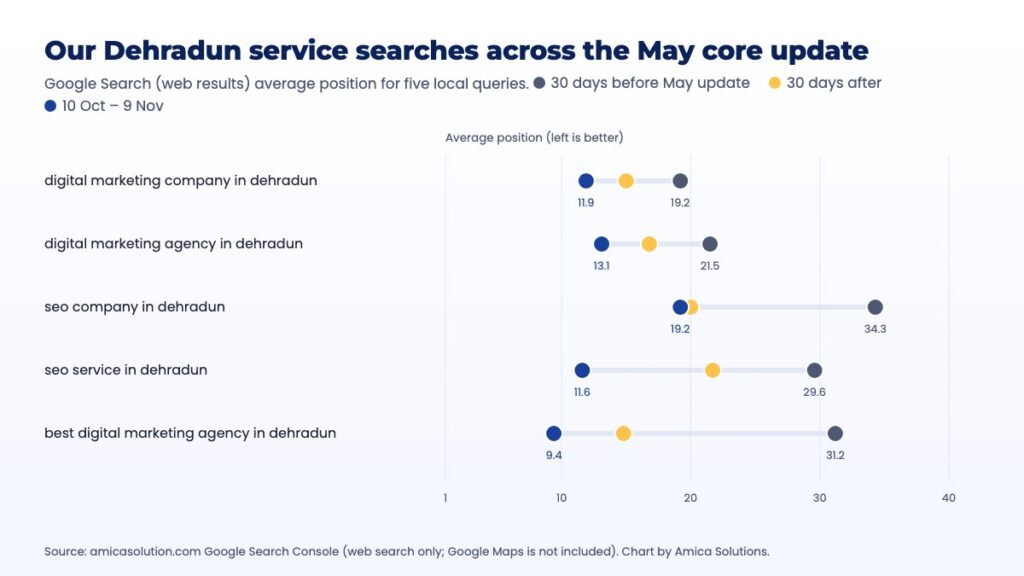
Our Dehradun service searches in Google web results across the May 2026 update. Source: our Google Search Console data.
Our Dehradun service searches improved across the May update and kept improving afterwards. We had been working on those pages, so again this is not proof of cause. For your own business, check the Performance section of your Google Business Profile (searches, calls and direction requests) separately from Search Console. If the profile numbers hold steady while web clicks move, the update is touching your website, not your listing. Our guide to improving your Google Business Profile ranking covers what you can control there.
What does Google reward after a core update?
Google says core updates reward helpful, reliable content written for people, not for search engines. Its self-assessment questions ask, among other things, whether a page gives original information, a complete description of the topic, and insight beyond the obvious, and whether a visitor would bookmark it or share it with a friend.
For a local business, that translates into very practical things:
- Your own photos of your shop, your team and real work, instead of stock images.
- Clear service details: what you do, where you do it, your hours and how to book.
- Real prices or price ranges, but only if you actually charge them and keep them up to date.
- Answers to the questions customers really ask on the phone or at the counter.
- Who is behind the business: names, experience and qualifications, where they matter to the customer.
None of this is new, and that is the point. Our longer guide on how to rank higher on Google goes through each of these in detail.
What should a local business do this week?
Keep the business running normally, fix only real faults, and write down your numbers. Here is how we would split the week:
| Do now | Leave alone until the rollout ends |
|---|---|
| Keep your Business Profile hours, phone number and photos current | Rewriting service pages that already bring enquiries |
| Fix real faults: site down, wrong “noindex”, broken forms or links | Deleting old blog posts in bulk |
| Reply to new reviews, good and bad | Changing page addresses (URLs) or the site’s structure |
| Note the date of every change you make to the site | Buying links or “guaranteed ranking” packages |
| Save a baseline from an ordinary October week | Judging the update from one or two days of data |
If you run Google Ads, remember that a core update is about the free, organic results. Your ads still compete in their own auction, which is one reason many local businesses use both. We compare the two in SEO vs Google Ads for a local business.
What else changed in Google Search this week?
Three smaller stories from the same week are worth knowing, with a caution on each:
- Ads inside AI Mode local answers. On 12 November 2026, PPC Land reported screenshots of a “Sponsored” group of local stores inside a Google AI Mode answer in the United States. Google had not commented. The same report notes that ads in AI Mode were announced for India and nine other countries on 28 October 2026. We have not seen the sponsored local format in India yet.
- Unexpected “Book online” buttons. Local SEO specialists reported booking buttons appearing on some Business Profiles that never set up booking, from around 6 November. This is not confirmed by Google, but it costs nothing to open your own profile and check every button works.
- A new Google page on tracking Search visits. As covered above, Google published guidance on 12 November on spotting Google Search visits in analytics.
Frequently asked questions
When did the Google November 2026 core update start?
Google listed it on its Search Status Dashboard on 10 November 2026; Search Engine Journal reported the start as 10:06 a.m. Pacific time, which is 11:36 p.m. in India. Google says the rollout may take up to two weeks.
My rankings dropped this week. Should I change my website?
Not yet, unless something is actually broken. Google advises against quick fixes, and rankings often move up and down during a rollout. Wait until it is marked complete, then compare a full week after it with a normal week before it.
How long does it take to recover from a core update?
Google says some improvements can show within days, but its systems may need several months to confirm them, and sometimes the change only shows at the next core update. There is no fixed recovery time.
Does a core update affect my Google Business Profile?
Google has not said so directly. Local results depend mainly on relevance, distance and prominence. Check your profile’s own Performance numbers alongside Search Console to see where any change is coming from.
Is a core update a penalty?
No. A core update changes how Google ranks pages in general. Penalties are manual actions, which appear in the Manual actions report in Search Console, and spam updates target pages that break Google’s spam policies.
Sources (checked 14 November 2026)
- Google Search Status Dashboard: ranking incidents 2026
- Google Search Central: Google Search core updates
- Google Search Central: Debugging drops in Google Search traffic
- Google Search Central: Identifying traffic from Google Search (added 12 November 2026)
- Google Business Profile Help: Tips to improve your local ranking
- Google Search Central: Creating helpful, reliable, people-first content
- Search Engine Journal: Google November 2026 core update starts rolling out (10 November 2026)
- Search Engine Roundtable: core updates and local rankings (2021)
- PPC Land: Google AI Mode local retailer ads (12 November 2026)
- amicasolution.com Google Search Console data, 1 January to 13 November 2026 (charts and tables in this article)