
Why Website Traffic Is Growing but Business Enquiries Are Falling in 2026
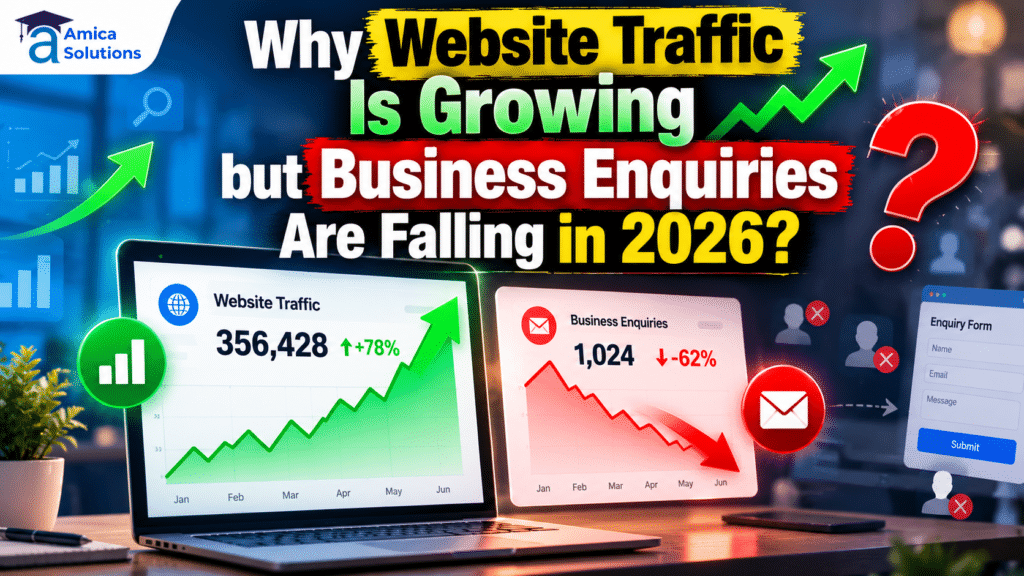
The most frustrating situation for any business owner is watching website traffic grow steadily while business enquiries remain stagnant. This scenario is more common than you think in 2026, where digital competition has intensified and visitor expectations have reached unprecedented levels.
Many Dehradun-based businesses and enterprises across India experience this gap. Your Google Ads campaigns might be driving thousands of monthly visitors, your SEO efforts might be ranking for competitive keywords, and your social media marketing might be generating impressive click-through rates—yet the phone remains silent and your contact forms collect digital dust.
This disconnect between website traffic and actual business enquiries reveals a fundamental problem that extends far beyond visitor numbers. The real issue lies in conversion strategy, user experience, and how effectively your website communicates value to potential customers.
Traffic Growth vs Lead Generation: What Is the Real Difference?

Before diving into solutions, let’s clarify what separates traffic growth from genuine lead generation.
Website traffic refers to the number of visitors landing on your pages. This metric includes everyone—curious browsers, competitors checking your site, accidental clicks, and genuinely interested prospects. Traffic is vanity metric if it doesn’t translate into business outcomes.
Business enquiries or qualified leads represent visitors who have shown genuine interest in your service by taking action—filling contact forms, calling your business, requesting quotes, or booking consultations. These are the visitors that actually move your business forward.
Traffic vs Leads: A Quick Comparison
| Aspect | Website Traffic | Business Enquiries |
|---|---|---|
| Definition | Total number of website visitors | Qualified visitors taking action |
| Source Variety | Broad mix of all visitor types | High-intent potential customers |
| Conversion Intent | Low to high (mixed) | High intent to purchase |
| Business Value | Limited without conversion | Direct revenue impact |
| Cost | Decreasing with optimized SEO | Increasing with better targeting |
| Tracking Method | Google Analytics sessions | CRM, contact forms, calls |
| Quality Variability | High variability | Consistent quality if filtered |
| 2026 Challenge | Easy to generate, hard to convert | Requires strategic optimization |
The gap between these two metrics represents lost revenue opportunities. According to conversion research, most websites convert less than 2% of their traffic into actual leads. For service-based businesses in Dehradun and across India, this percentage is often even lower.
Why Increasing Website Visitors May Not Generate More Enquiries
Growing your website traffic doesn’t automatically increase business enquiries. In fact, poorly targeted traffic can worsen your conversion metrics and waste marketing budget.
The Traffic Quality Problem: Not all website traffic is created equal. Your lead generation campaigns might attract users searching for information rather than actively looking to buy. Someone searching “how to fix website traffic” isn’t the same as someone searching “best digital marketing agency in Dehradun.”
Mismatch Between Marketing and Sales: Your marketing team drives traffic through SEO, PPC, and social media, but your sales funnel isn’t equipped to handle these visitors. There’s no clear path from landing on your homepage to requesting your service.
Weak Value Proposition: Visitors land on your page but don’t see immediately why they should trust you or choose your services over competitors. Without clear differentiation, they bounce to your competitor’s website.
Poor Mobile Experience: In 2026, over 70% of website traffic comes from mobile devices. If your site isn’t optimized for mobile users, you’re losing the majority of potential leads right at the entry point.
How to Identify Low-Intent Traffic and Audience Mismatch
The first step toward improving your enquiry rate is identifying which traffic sources are actually valuable.
Use Google Analytics 4 segmentation to analyze traffic by source:
- Organic search visitors (typically higher intent)
- Paid Google Ads traffic (quality depends on keyword targeting)
- Social media traffic (often lower intent)
- Direct visitors (usually returning, interested users)
- Referral traffic (depends on referring source)
Track visitor behavior: Which pages do people visit? How long do they stay? Do they view multiple pages or leave immediately? Visitors spending 30 seconds on your homepage and bouncing are low-intent traffic.
Review your keyword strategy: Are you ranking for keywords that match your service offerings? Someone searching “free website traffic tools” isn’t looking to hire a digital marketing agency. Someone searching “digital marketing services in Dehradun” is a qualified prospect.
Analyze conversion funnels: Where do visitors drop off? Do they abandon after viewing your services page? This indicates a content or UX problem, not a traffic problem.
Website Design and User Experience Issues That Reduce Conversions
Your website design and development directly impacts whether visitors become enquiries.
Poor Navigation: If visitors can’t easily find your service page, contact form, or pricing information, they’ll leave. Your website structure should guide visitors toward conversion points.
Confusing Value Proposition: Your homepage should immediately communicate what you do and why someone should choose you. If a visitor has to dig through multiple pages to understand your service, you’ve lost them.
Lack of Trust Signals: No testimonials, client logos, case studies, or certifications visible. Modern website visitors expect social proof before engaging.
Outdated Design: A website that looks like it was built in 2015 signals that your business isn’t current or professional. Web design credibility directly impacts conversion rates.
Excessive Pop-ups and Distractions: While pop-ups can generate leads, too many create friction and increase bounce rates.
Working with Amica Solutions’ web development team ensures your site is designed for conversion, not just aesthetics.
The Impact of Slow Page Speed and Poor Mobile Experience
Page speed is no longer a nice-to-have feature—it’s a conversion requirement.
Statistics: Pages that load in under 2 seconds have conversion rates 2-3x higher than pages taking 5+ seconds. A one-second delay reduces conversions by 7%.
Mobile-First Reality: Google’s mobile-first indexing means your mobile experience directly affects your search rankings and visibility. Poor mobile experience means:
- Lower search rankings
- Higher bounce rates
- Fewer form submissions
- Lost business enquiries
Core Web Vitals: Google now factors page speed and mobile usability into ranking algorithms. A slow website is a invisible website.
Test Your Speed: Use Google PageSpeed Insights to identify specific speed issues on your key pages. Optimize images, enable caching, and consider CDN solutions.
How Weak Calls to Action and Complicated Forms Lose Potential Leads
Many websites have excellent content but terrible conversion mechanics.
Weak CTAs: Generic “Contact Us” buttons don’t convert as well as specific action-oriented CTAs like “Book Your Free Consultation” or “Get Your Free SEO Audit.”
Form Friction: Long forms asking for 10+ fields reduce completion rates dramatically. Ask for only essential information initially.
Hidden Contact Options: Your phone number, email, and contact form should be visible without scrolling. Make contacting you effortless.
No Value Offer: “Contact us” feels generic. Instead, offer something specific: “Get a free 30-minute strategy session” or “Receive your personalized lead generation plan.”
Confusing Navigation to Forms: Visitors shouldn’t have to hunt for your contact page. Place clear CTA buttons throughout your website.
Trust Signals, Reviews and Service Information: Why They Matter
In 2026, trust is the currency of online business. Websites without trust signals see significantly lower conversion rates.
Customer Reviews: Display real testimonials and case results prominently. Platforms like Google Reviews, Trustpilot, and your website testimonials build credibility.
Case Studies: Show specific results from past projects. “Increased leads by 150% in 4 months” is more convincing than generic praise.
Service Clarity: Clearly explain what you offer and how it benefits customers. Use case studies from Amica Solutions as reference.
Professional Credentials: Display industry certifications, awards, partnerships, and associations.
Clear Pricing or Investment Ranges: Uncertainty about cost prevents enquiries. Transparency builds trust.
About Your Team: People buy from people. Show who will be working on their project.
How to Use Google Analytics 4 to Find Conversion Drop-Offs
GA4 is essential for identifying exactly where your traffic is abandoning your conversion funnel.
Set Up Conversion Events: Define what counts as a conversion—form submission, phone call, page view, demo request.
Create Custom Funnels: Visualize the path from landing page → services page → contact form → submission. Where do users drop off?
Analyze Landing Page Performance: Which landing pages have the highest conversion rates? Which have the highest bounce rates? Optimize accordingly.
Track User Flow: Understand how visitors navigate your site. Are they discovering your key conversion pages?
Segment Traffic Quality: Compare conversion rates across traffic sources. Which marketing channels deliver the highest-quality visitors?
Monitor Mobile vs Desktop: Is your mobile conversion rate significantly lower? This indicates a mobile UX problem.
Regular GA4 analysis is essential for continuous improvement. Many businesses never analyze their data deeply enough to identify conversion barriers.
Strategies to Turn Existing Website Traffic into Qualified Leads
Now that you understand the problems, here are actionable strategies to convert more website traffic into business enquiries.
1. Implement Audience Targeting
With PPC and Google Ads expertise, you can attract high-intent traffic by targeting specific keywords, locations, and demographics. Stop paying for low-quality traffic.
2. Optimize Landing Pages
Create dedicated landing pages for each marketing campaign or service offering. Generic homepages convert poorly. Specific landing pages convert 2-3x better.
3. Improve Website Conversion Path
Make it simple to convert: clear value proposition → service details → strong CTA → easy contact method. Remove distractions and friction.
4. A/B Test Everything
Test different headlines, CTAs, form fields, and page layouts. Small improvements compound into major conversion gains.
5. Use Retargeting Campaigns
Many visitors aren’t ready to convert on first visit. Retarget these users with ads reminding them of your services.
6. Implement Live Chat
Real-time assistance increases conversion rates. Visitors with questions get immediate answers, leading to more enquiries.
7. Create Compelling Service Content
Content marketing that addresses customer pain points builds trust and positions you as an expert. Helpful content converts better than salesy content.
8. Optimize for Local Search
For location-based services, local SEO and Google Business Profile optimization are essential for attracting nearby customers actively searching for your services.
Key Website Conversion Metrics Every Business Should Track
Stop obsessing over vanity metrics. Track metrics that actually matter for business growth.
Essential Conversion Metrics:
| Metric | Formula | Why It Matters |
|---|---|---|
| Conversion Rate | (Conversions ÷ Visitors) × 100 | % of traffic turning into leads |
| Cost Per Lead | Total Marketing Spend ÷ Number of Leads | Direct ROI measurement |
| Bounce Rate | (Single-session users ÷ Total sessions) × 100 | Page engagement quality |
| Average Time on Page | Total time on page ÷ Total pageviews | Content engagement indicator |
| Cost Per Acquisition | Total cost ÷ Number of customers | True marketing ROI |
| Lead Quality Score | (Qualified leads ÷ Total leads) × 100 | Sales-ready lead percentage |
| Form Completion Rate | (Completed forms ÷ Form views) × 100 | CTA and form effectiveness |
| Return on Ad Spend (ROAS) | Revenue ÷ Ad spend | Campaign profitability |
Track these metrics monthly and set improvement targets. If your conversion rate is 0.5%, aim for 0.8% next month. Small improvements compound.
Conclusion: Building a Website That Generates Enquiries, Not Just Traffic
Start by auditing your current situation. Analyze your Google Analytics data to identify where visitors are dropping off. Review your website to spot trust and conversion barriers. Test different approaches and measure results.
If you’re experiencing website traffic with no leads, you need a comprehensive conversion strategy—not just more traffic. This is where professional digital marketing expertise matters.
Amica Solutions specializes in converting website traffic into qualified business enquiries. Our team combines SEO expertise, conversion rate optimization, lead generation strategies, and website design that converts.
Request Your Free Website Conversion Audit from Amica Solutions and discover exactly where your conversion leaks are and how to fix them.
Contact Us
Recent Posts




Written and reviewed by
Amica Solutions Team
Amica Solutions is a digital marketing company in Dehradun working on SEO, Google Business Profile management, Google Ads, social media marketing, content marketing, website development, and lead generation for local businesses.
- Office: Laxmi Tower, Near Sahastradhara Road, B Block, Aman Vihar, Dehradun, Uttarakhand 248001
- Phone: +91 9411339575
- Email: contact@amicasolution.com