
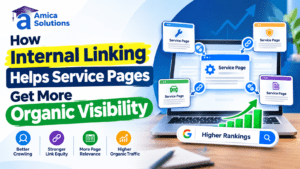
How Internal Linking Helps Service Pages Get More Organic Visibility
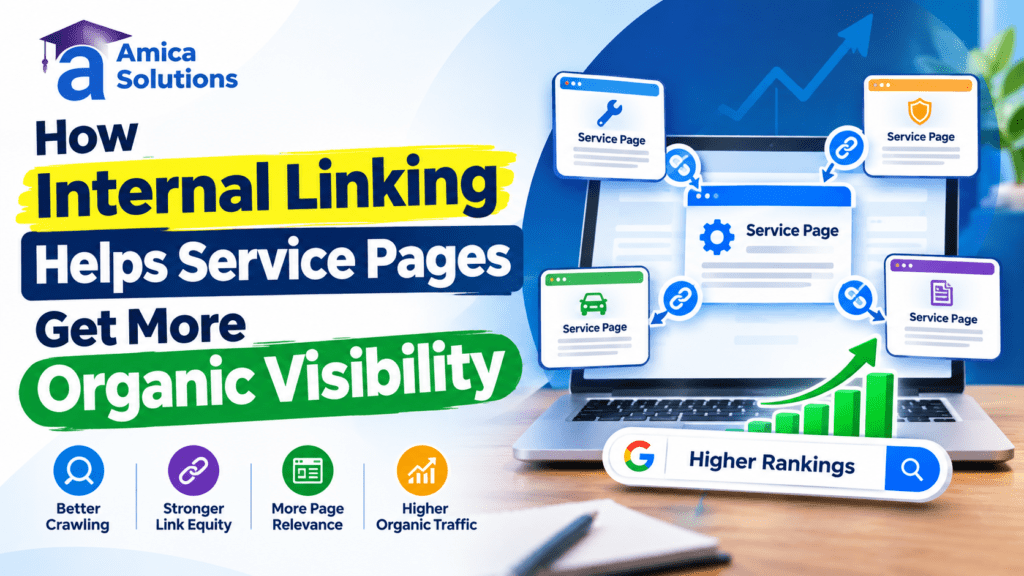
Service pages are the backbone of your online business. They explain what you offer, how you solve problems, and why customers should choose you. But having great service pages isn’t enough if no one can find them in search results.
This is where internal linking helps service pages achieve better organic visibility on Google.
Most businesses invest heavily in creating quality service pages—writing detailed descriptions, adding images, and optimizing for keywords. Yet they struggle to rank because these pages lack the internal link authority needed to compete. This guide shows you exactly how internal linking helps service pages get discovered, trusted by search engines, and ultimately seen by more customers.
Whether you run a digital marketing agency like Amica Solutions, offer SEO services, provide website development, or manage social media marketing services, strategic internal linking is critical to organic success.
What Is Internal Linking and Why Does It Matter for SEO?
Internal linking is the practice of linking from one page on your website to another page on the same domain. When you link from your homepage to a service page, or from a blog post to a specific service offering, you’re creating internal links.
Search engines like Google use these links as signals of importance. When multiple pages on your site link to a service page, Google interprets this as a sign that the page is valuable and relevant to your business.
External links (links from other websites) have long been recognized as ranking factors. But internal links are equally powerful—sometimes even more so—because you control them entirely. You can optimize them specifically for the pages that matter most to your business goals.
According to Moz’s ranking factors research, link authority (both internal and external) remains one of the top three SEO ranking signals. Internal linking helps distribute this authority across your site strategically.
How Internal Linking Helps Service Pages Get More Organic Visibility
The relationship between internal linking and service page visibility is direct and measurable.
Internal linking helps service pages in four primary ways:
- Authority Transfer: Linking from high-authority pages (like your homepage) passes ranking authority to service pages
- Crawlability: Internal links guide search engine bots to discover and index your service pages faster
- Relevance Signals: Contextual internal links tell Google what your service pages are about
- User Engagement: Internal links encourage visitors to explore more of your services, reducing bounce rates
When a visitor lands on your homepage and sees a link to your PPC and Google Ads service, they’re more likely to click. When Google’s crawler finds that same link, it understands that this service page is important to your business.
Without internal linking, even exceptional service page content struggles to rank because it receives no authority boost from other pages. With strategic internal linking, the same content can climb several positions in search results.
How Internal Links Help Search Engines Discover Service Pages
Google uses automated bots (crawlers) to navigate websites, following links to discover and index new pages. If your service pages aren’t linked from anywhere, crawlers might miss them entirely.
Internal linking helps service pages by creating clear pathways for search engine bots. Consider this scenario:
- A new client visits your website and lands on your homepage
- The homepage has navigation links to all major service categories
- From there, links lead to specific service pages (like Local SEO services)
- These pages link to case studies, service details, and related offerings
This structure creates a logical hierarchy that bots can easily follow. Google can now discover your entire service offering and understand the relationships between pages.
Pages that are only reachable through deep navigation menus or lacking internal links from other pages face what’s called the “deep crawl problem.” They exist on your site but remain virtually invisible to search engines.
Pro tip: The most important pages (like your homepage) should have the most internal links. This concentrates authority where it matters most—on pages designed to convert visitors.
Using Internal Linking to Improve Service Page Authority
Domain Authority (a metric developed by Moz) measures the overall ranking power of your website. Page Authority measures the ranking power of individual pages.
Internal linking helps service pages accumulate page authority. Here’s how:
When your homepage (typically your site’s highest-authority page) links to a service page, it passes a portion of its authority to that page. This is why links from your homepage to key services are more valuable than links from a sidebar or footer.
Authority Distribution Example
If your homepage has authority score of 100, you want it distributed wisely:
- Homepage links to 5 main service pages = each receives authority boost
- Service pages link to related content (blog posts, case studies) = they distribute authority further
- Blog posts link back to relevant services = reciprocal authority flow
This creates an interconnected authority network. Over time, service pages receiving consistent internal links from high-authority pages gain their own ranking power.
How to Choose the Right Pages to Link to Your Services
Strategic internal linking isn’t about linking everywhere to everything. It’s about intentional, purposeful connections.
Ask yourself these questions when deciding which pages to link to your services:
- Is the link relevant? Does the content naturally mention this service?
- Does the source page have authority? Is it likely to rank well?
- Will users find value in the link? Would a visitor want to click it?
- Does the target page need a ranking boost? Are you trying to rank it for competitive keywords?
For example, if Amica Solutions publishes a blog post about why your business isn’t showing on Google Maps, it makes perfect sense to link to the Google Business Profile management service page. The connection is natural and valuable for readers.
Contrast this with randomly linking to unrelated services—that confuses both users and search engines.
Best Internal Linking Practices for Service Pages
1. Link from Content That Ranks
Prioritize internal links from pages that already rank well in search results. If your blog post about “digital marketing strategies” ranks #5 on Google, internal links from that post are especially valuable.
2. Use Contextual Links
Links within body content (contextual links) are more powerful than navigation or sidebar links. When you naturally mention a service within an article and link to it, that carries more weight than menu links.
3. Maintain Appropriate Link Density
While you want multiple internal links pointing to important service pages, don’t overdo it. A typical blog post of 2,000 words might contain 3-5 relevant internal links.
4. Implement a Siloed Structure
Group related content together. Pages about lead generation might link to each other, separate from pages about social media marketing. This creates topical authority clusters.
How Anchor Text Influences Internal Linking for Service Pages
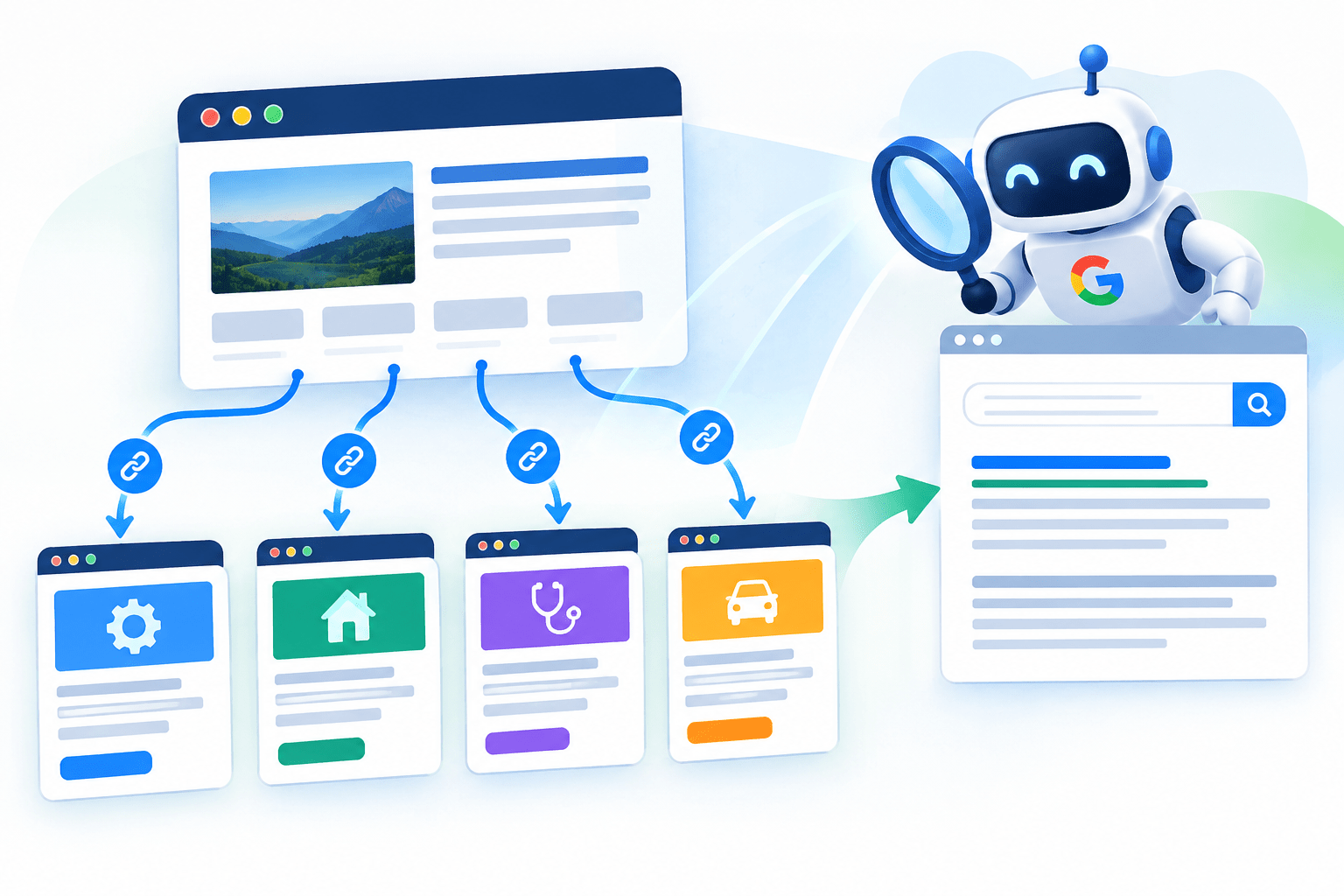
Anchor text is the clickable text of a link. It tells both users and search engines what the linked page is about.
Weak anchor text: “Click here” or “Learn more”
Strong anchor text: “SEO services” or “Local SEO in Dehradun“
When internal linking helps service pages rank, anchor text plays a crucial role. Google uses anchor text to understand the topic relevance of your service pages. If you link to your website development service using the anchor text “website development,” you’re signaling that this page is about website development.
However, anchor text should always feel natural. Over-optimization (using the exact keyword in every link) is considered a “grey hat” tactic and can trigger spam filters.
Balanced approach: Mix branded anchor text (“Amica Solutions website service”), descriptive anchor text (“mobile-friendly website design”), and partial-match anchor text (“our web development team”).
How Many Internal Links Should a Service Page Have?
There’s no single “perfect” number, but here’s a practical framework:
| Page Type | Internal Links (In) | Internal Links (Out) | Purpose |
|---|---|---|---|
| Homepage | N/A | 15-25 | Link to all main services and resources |
| Service Page | 5-10 | 5-8 | Receive authority, link to related content |
| Blog Post | Varies | 3-5 | Support with contextual internal links |
| Resource Page | 3-5 | 5-10 | Link to relevant services and guides |
| Case Study | 3-5 | 4-6 | Link to applicable service pages |
A typical service page should:
- Receive links from at least 5-10 other pages (homepage, related content, blog posts)
- Link out to 5-8 related pages (other services, supporting content, relevant guides)
The focus should be quality over quantity. Five highly relevant internal links from authoritative pages beat fifty random links any day.
Creating an Effective Internal Linking Structure for Multiple Services
If you offer multiple services (like Amica Solutions with SEO, PPC, website design, and social media marketing), organize your internal linking strategically.
Tier 1 Structure:
- Homepage links to main service categories
Tier 2 Structure:
- Service category pages link to specific services
- Example: “Digital Marketing Services” page links to PPC, Lead Generation, and Link Building
Tier 3 Structure:
- Individual service pages link to:
- Related services
- Relevant case studies
- Support blog content
- Resource guides
This creates a pyramid structure where authority flows from the homepage down through service categories to individual service pages.
How Internal Linking Supports Better User Navigation and Engagement
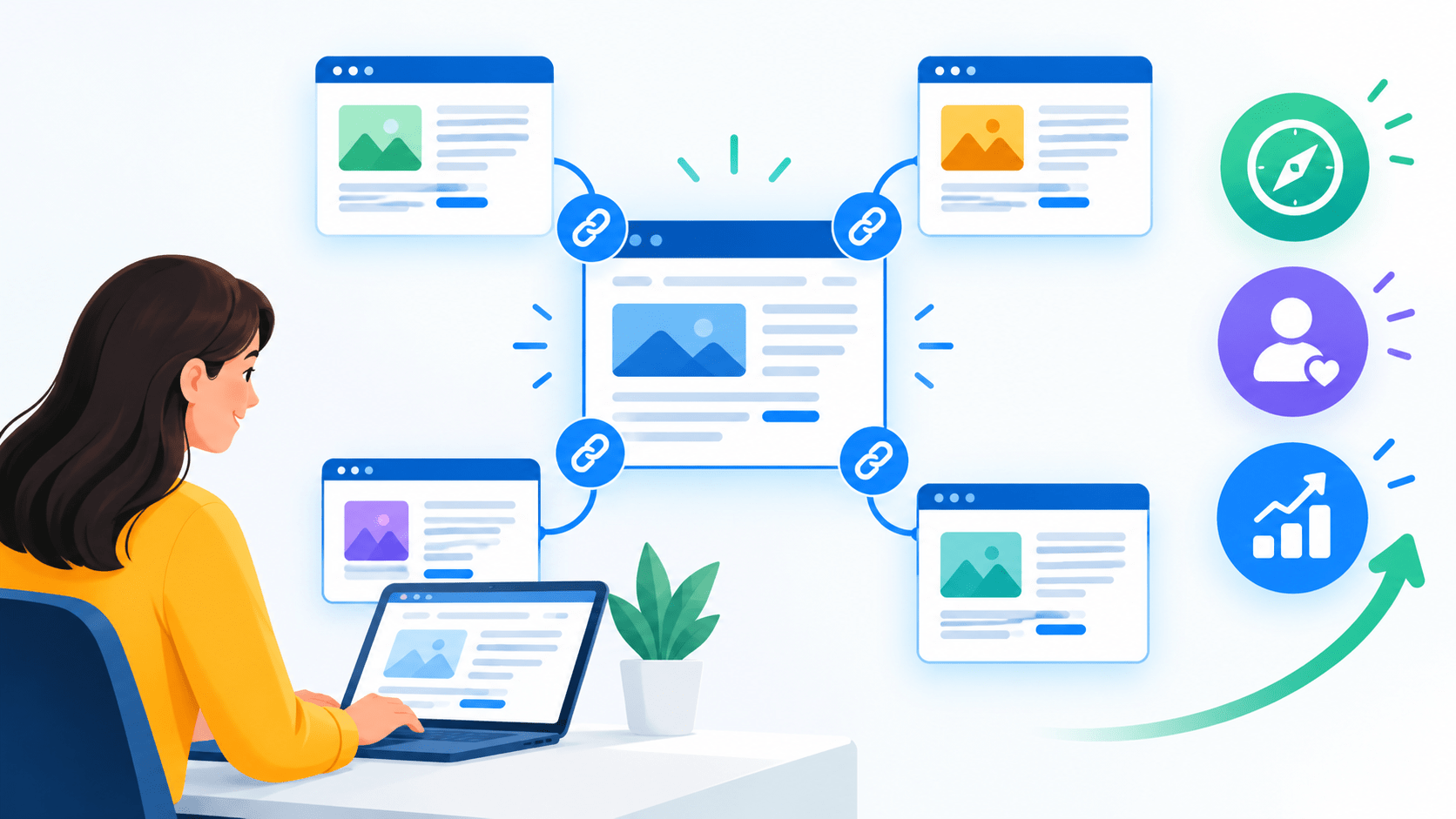
Beyond SEO, internal linking improves user experience. Visitors who can easily navigate between related services spend more time on your site and are more likely to request consultations.
Consider a user researching digital marketing for their Dehradun business:
- Lands on homepage
- Clicks link to “Digital Marketing Services“
- Clicks link to “SEO Services“
- Sees internal link to “Local SEO“
- Reads success stories and requests consultation
This journey is enabled entirely by strategic internal linking. Without these links, the user might leave after step 1.
Metrics like average session duration and pages-per-session improve when internal linking keeps visitors engaged. These engagement signals also factor into Google’s ranking algorithms.
How to Measure the SEO Impact of Internal Links on Service Pages
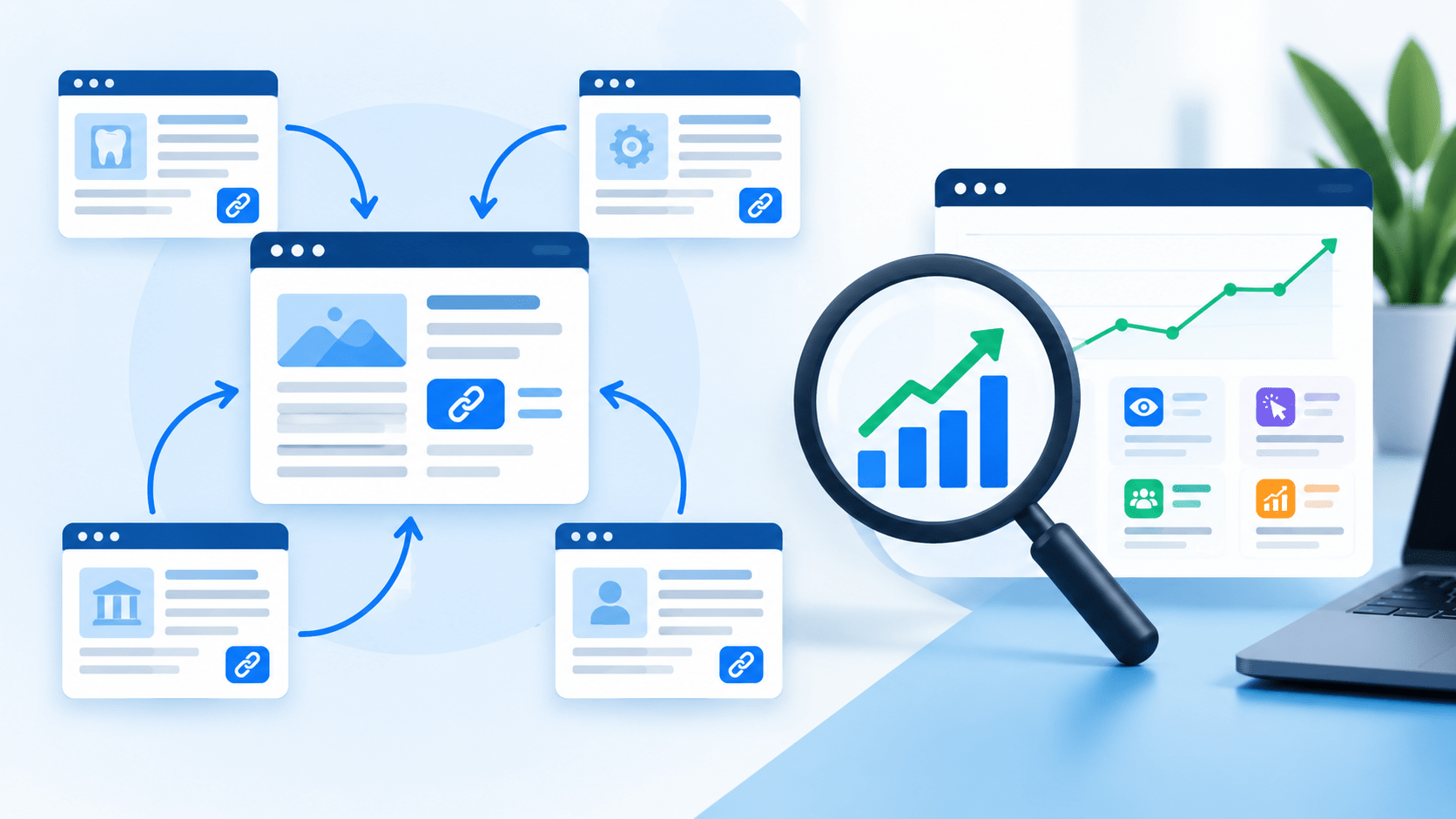
Measuring internal link impact requires the right tools and tracking:
Tools for Tracking Internal Links:
- Google Search Console: Shows which internal links drive clicks to service pages
- Google Analytics: Tracks user navigation patterns and which links users click
- Screaming Frog SEO Spider: Audits your entire site’s internal linking structure
- Semrush/Ahrefs: Identifies link opportunities and authority distribution
Key Metrics to Monitor:
- Organic Traffic to Service Pages: Track month-over-month increases
- Keyword Rankings: Monitor service page position changes for target keywords
- Click-Through Rate: See if internal links increase clicks from search results
- Internal Search Flow: Which internal links users click most in Google Analytics
Example: If you add 10 new internal links pointing to your website development service and notice organic traffic increases 25% the following month, you’ve measured the impact.
Internal Linking Strategy for Improving Service Page Rankings
A comprehensive internal linking strategy for service pages follows these steps:
Month 1: Audit & Analysis
- Identify which service pages need ranking boosts
- Audit current internal linking structure
- Find high-authority pages that could link to services
Month 2-3: Implementation
- Add contextual internal links from blog posts to services
- Update homepage navigation to include target services
- Create internal link pathways between related services
Month 4-6: Optimization
- Monitor rankings and organic traffic
- Refine anchor text where needed
- Add strategic links from newly published content
Ongoing: Maintenance
- Regularly audit for broken internal links
- Update internal links as new content is published
- Adjust strategy based on performance data
This phased approach ensures sustainable improvements without appearing manipulative to search algorithms.
Conclusion: Building Stronger Organic Visibility Through Internal Linking
Service pages are too valuable to leave to chance. Without strategic internal linking, even excellent content struggles to achieve its ranking potential.
Internal linking helps service pages by:
- Passing authority from high-ranking pages
- Helping search engines discover your services
- Creating logical navigation for users
- Building topical relevance clusters
- Supporting better engagement metrics
The businesses that dominate search results in their niches—including leading digital marketing companies in Dehradun—understand that internal linking is foundational to SEO success.
Call us at +91 9411339575
or visit amicasolution.com to book a free consultation.
Visit us at – Amica Solutions Pvt. Ltd
Frequently Asked Questions
1. How does internal linking help service pages get more organic visibility?
Internal linking helps search engines discover, crawl, and understand service pages while passing relevant authority from other pages on the website.
2. Where should I add internal links to service pages?
Add relevant internal links from blog posts, related service pages, location pages, homepage sections, and other high-value pages where the link naturally supports the topic.
3. What anchor text should I use for internal links to service pages?
Use descriptive, relevant anchor text that clearly explains the linked service. Avoid using the exact same keyword-rich anchor text repeatedly across the website.
4. Can internal linking improve service page rankings?
Yes. A well-planned internal linking structure can help search engines understand the importance and topical relevance of service pages, which may support better organic rankings.
5. How often should I review internal links on service pages?
Review your internal links regularly, especially after adding new content or services, to identify broken links, outdated references, and new opportunities to connect relevant pages.
Contact Us
Recent Posts



Written and reviewed by
Amica Solutions Team
Amica Solutions is a digital marketing company in Dehradun working on SEO, Google Business Profile management, Google Ads, social media marketing, content marketing, website development, and lead generation for local businesses.
- Office: Laxmi Tower, Near Sahastradhara Road, B Block, Aman Vihar, Dehradun, Uttarakhand 248001
- Phone: +91 9411339575
- Email: contact@amicasolution.com